
Inside the question engineOpen the field notes
We draw one projection from a pool of 18 maps and add 3 distractors. This quiz does not use percentage bands.
The map projection quiz: how it works
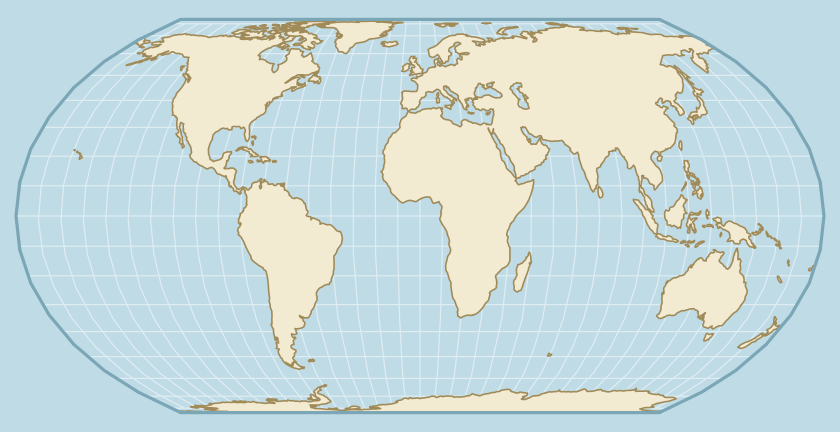
This quiz tests whether you can recognize a map projection from the shape of its grid and landmasses, with no label. Every projection distributes distortion differently, so the shape of the map reveals what it preserves and what it gives up.
How does the quiz draw the projections?
Each round has 10 questions. Each time we draw one of 18 projections and add 3 wrong answers. This quiz has no difficulty bands, because every projection looks different.
Where do the maps and projection descriptions come from?
The pool comes from the RealSize.World projection catalog, and the maps are drawn with the d3-geo library from Natural Earth outlines. Each projection is described in its own guide.
A fact: the newest and the oldest projection
The newest projection in the pool is the Equal Earth projection from 2018. Projections with roots before the Common Era: orthographic projection, gnomonic projection.
Frequently asked questions
How can you tell the Mercator projection from the Robinson?
Mercator projection: meridians and parallels form a rectangular grid, and the spacing between parallels grows toward the poles, so polar regions are hugely enlarged. Robinson projection: parallels are straight lines, meridians are gentle curves, and the poles are lines about half as long as the equator.
Which projections in the quiz are equal-area and which are conformal?
Equal-area, meaning they keep areas true: Gall-Peters, Mollweide, Equal Earth, Werner Projection and Interrupted Goode Homolosine. Conformal, meaning they keep angles true: Mercator, Peirce Quincuncial, August Epicycloidal and Spilhaus Projection. No flat projection of a sphere keeps both areas and angles true.
Why do some projections in the quiz have gaps?
Gaps in the grid reduce distortion at the cost of a continuous map. The interrupted ones are Berghaus Star, Waterman Butterfly, Airocean (Dymaxion), Spilhaus Projection and Interrupted Goode Homolosine.